
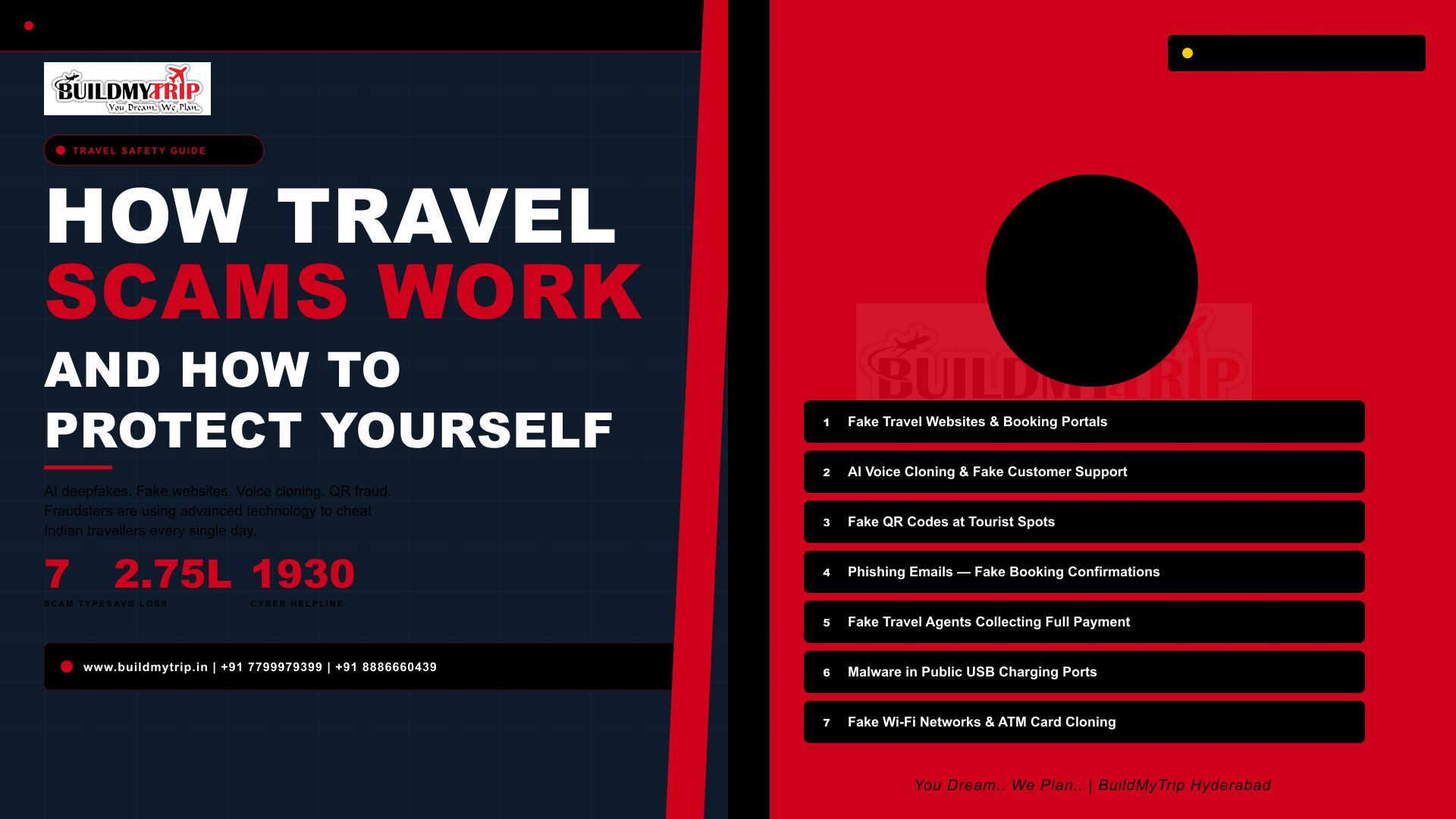
You planned your dream trip for months. You saved money, took leave from work, packed your bags with excitement. And then — somewhere between the airport and your hotel — a scammer took it all away in minutes.
This is not rare. This is happening every single day to Indian travellers going abroad and even within India itself.
What makes it worse in recent times is that fraudsters are no longer just random strangers on the street. They are now using advanced technology — artificial intelligence, deepfakes, fake websites and voice cloning — to cheat travellers in ways that are almost impossible to detect without preparation.
At BuildMyTrip, we have seen customers come to us after being cheated by fake agents. We built our company to be the honest alternative. Today we are giving you the complete guide to how travel scams work so you never fall for them.
Why Travel Scams Are More Dangerous Than Ever
INTERPOL has officially called this the "industrialisation of fraud." Criminal organisations are no longer small operations run by one or two people. They now run like proper businesses — with teams, technology, and systems designed to target thousands of travellers at the same time.
The year is notable for the integration of autonomous AI into the fraudulent ecosystem, with these technologies used to bypass traditional security measures through hyper-realistic simulations and automated social engineering.
In simple words — scammers now have access to the same technology that big companies use. And they are using it against you.
Scam 1 — Fake Travel Websites That Look Exactly Real
This is the biggest and most dangerous scam happening right now.
Scammers create professional-looking duplicates of legitimate portals, often using paid sponsored advertisements on search engines like Google and social media sites to ensure their fraudulent links appear at the top of search results.
You search "Europe tour packages from Hyderabad" on Google. The first result looks completely real — it has photos, prices, reviews and even a phone number. You book. You pay. And when you arrive at your destination, nothing exists.
False hotel reservations have become so high-profile that the matter was taken to Parliament. Scam artists launch websites that look like famous hotels or booking portals. Tourists pay beforehand only to arrive and realise that the hotel does not exist.
How to protect yourself:
- Always check if the website has a physical office address
- Search the company name plus "reviews" and "scam" before booking
- Pay by credit card — it has chargeback protection
- Book only through verified agents registered with the Ministry of Tourism
Scam 2 — AI Voice Cloning and Fake Customer Support
This is terrifying and it is happening right now. One of the most psychologically damaging developments is the use of AI voice cloning.
A scammer calls you pretending to be from MakeMyTrip or your airline. The voice sounds completely real — professional, polite, even using your booking details. They tell you your flight has been cancelled and you need to pay a small fee to rebook. You pay. The money is gone.
A 70-year-old businessman in Mulund lost 2.75 lakh because of searching a customer care number of a travel portal online. He found a phone number and dialled it, and was requested by the caller to proceed on WhatsApp. The scammer duped him using his debit card by posing as an executive.
How to protect yourself:
- Never search for customer care numbers on Google — always go to the official website directly
- Airlines and hotels never ask for card details over WhatsApp
- If someone calls you about your booking — hang up and call the official number yourself
Scam 3 — Fake QR Codes
You see a QR code at a restaurant, museum or tourist spot. You scan it. It takes you to a website that looks real but quietly steals your payment details or installs malware on your phone.
Fraudsters love QR codes because they are easy to fake and redirect travellers straight to a phishing site that steals payment information or login details. Security experts highlight that it is not easy to verify if QR codes are legitimate.
How to protect yourself:
- Only scan QR codes that staff physically show you
- Never scan codes pasted on walls or stuck over printed materials
- If a QR code asks for payment details — close immediately and pay directly
Scam 4 — Fake Phishing Emails That Look Like Real Booking Confirmations
Flight delay notifications, urgent messages from airlines, and fake booking confirmations now look almost identical to the real thing. AI lets fraudsters copy logos, branding and even booking details, making these emails impossible to ignore when you are tired, distracted or in the middle of a journey.
You get an email saying your hotel booking is cancelled and you need to click a link to rebook immediately. The email has the exact logo, fonts and colours of the real company. You click. You enter your details. You are scammed.
How to protect yourself:
- Never click links in emails about your booking — always go directly to the website
- Watch for warning signs — unexpected confirm your booking links, prices way below market value
- Airlines never charge for rebooking through pop-ups or private messages
Scam 5 — Fake Travel Agents and Tour Operators
This one hits closest to home for Indian travellers — especially those from Hyderabad planning pilgrimage tours, Europe trips or international packages.
Based on real-life experiences of elderly persons who were ripped off by fake travel agencies, families who were ripped off in Umrah frauds and pilgrims who were duped by AI-generated sites — awareness is the best protection.
Fake agents collect full payment upfront, issue fake tickets and itineraries, then disappear. By the time you reach the airport or the destination, it is too late.
How to protect yourself:
- Check the agent's registration on the Ministry of Tourism approved list
- Never pay the full amount upfront — pay in installments
- Always read reviews and ask for references from past customers
- Pay by credit card — not UPI or cash — so you can dispute the charge
Scam 6 — Public USB Charging Port Malware
This sounds technical but it is very simple to understand. You are at the airport, your phone is dying, you plug it into a public USB charging port.
Fraudsters can install malware or data-stealing equipment in public USB charging ports found at airports. Hackers can access a tourist's smartphone in seconds without them even realising.
Once your phone is hacked, they can access your banking apps, email, photos and travel documents.
How to protect yourself:
- Always carry your own power bank
- Use your own charging cable with a power adapter — never a USB port directly
- If you must use public charging, use a charge-only USB data blocker
Scam 7 — Classic Street Scams That Are Still Happening
Even with all the new technology, the old scams are still very much alive — especially within India.
The most common India tourist scams are taxi and tuk-tuk overcharging, fake tourist offices especially near New Delhi Railway Station, hotel-switching scams where drivers claim your booked hotel is closed, gem and carpet investment scams, and fake guides at major monuments.
Fraudsters also set up fake Wi-Fi networks to steal your data or tamper with ATMs to clone cards. A stranger befriends you, then lures you to an overpriced bar, tea shop or gem store, earning commission.
How to protect yourself:
- Use only ride-hailing apps like Uber and Ola — never negotiate with random drivers
- Use ATMs inside banks — never standalone ATMs on streets
- Never use public Wi-Fi — use your mobile data or a VPN
- If a stranger approaches you out of nowhere with a "great offer" — walk away
The Red Flags That Should Stop You Immediately
No matter what type of scam it is, these warning signs appear every time:
- Price is significantly lower than everywhere else
- They pressure you to pay immediately — "offer expires today"
- They only accept cash, UPI or bank transfer — not credit card
- No physical office address or verifiable registration
- Customer care number found on Google instead of official website
- They ask for card details or OTP over WhatsApp or phone
- The website URL has small spelling differences from the real one
How to Report Travel Scams in India
If you have been scammed — do not be silent. Report it immediately:
- National Cyber Crime Helpline: 1930
- India Cyber Crime Portal: cybercrime.gov.in
- Tourist Police: Available at all major airports and tourist spots
- Emergency: 112
Getting an official police report is important because your travel insurance may cover scam-related losses if you have documentation.
How BuildMyTrip Keeps You Protected
We are a verified, registered travel agency based in Hyderabad. We have been helping customers plan safe, honest and transparent trips for years.
Here is what we do differently:
- Full transparent pricing — you see every cost before paying anything
- We never collect full payment before your trip is confirmed
- Physical office in Hyderabad — you can walk in and meet us
- Verified tickets, hotel bookings and itineraries — all authentic
- 24/7 WhatsApp support — even when you are travelling abroad
- All bookings on credit card — so you always have chargeback protection
Before booking with any travel agent — ask them these three questions. Can I see your Ministry of Tourism registration? Can you give me references of past customers? Can I pay by credit card?
If they hesitate on any of these — walk away.
Book Your Trip the Safe Way
Do not let fear stop you from travelling. The world is beautiful and most experiences are wonderful. You just need to travel smart and book with people you can trust.
Call or WhatsApp us today for a FREE consultation and a fully transparent quote.
📞 +91 7799979399 📞 +91 8886660439 🌐 www.buildmytrip.in 📍 Hyderabad, Telangana
You Dream.. We Plan..
