
You searched for a flight to Dubai last Tuesday. The price was ₹18,000. You came back on Thursday to book it. The price was ₹24,500. You waited over the weekend thinking it might drop. By Monday it was ₹28,000.
You did nothing wrong. You were not unlucky. You were being priced by an algorithm that knows more about your behaviour than most people in your life.
This is not a conspiracy theory. This is how airline pricing actually works in 2026 — and once you understand the system, you can start making it work in your favour instead of against you.
At BuildMyTrip, we book flights for hundreds of customers every month from Hyderabad. We watch ticket prices move in real time, we understand the patterns, and we want to share everything we know with you.
The Old Way — How Airlines Used to Price Tickets
Twenty years ago, airline pricing was simple. Airlines had fixed fare categories — economy, business, first class. Within economy there were a limited number of price buckets — maybe ten or fifteen tiers from cheapest to most expensive. As seats sold, cheaper buckets would close and you would move to the next price tier. Prices did change but slowly and predictably.
A trained pricing analyst sitting at a desk would look at historical booking data, decide how many seats to put in each bucket, and adjust occasionally. The system was rigid, often inaccurate, and left a lot of revenue on the table for airlines.
That world is completely gone.
The New Reality — How Airlines Price Tickets in 2026
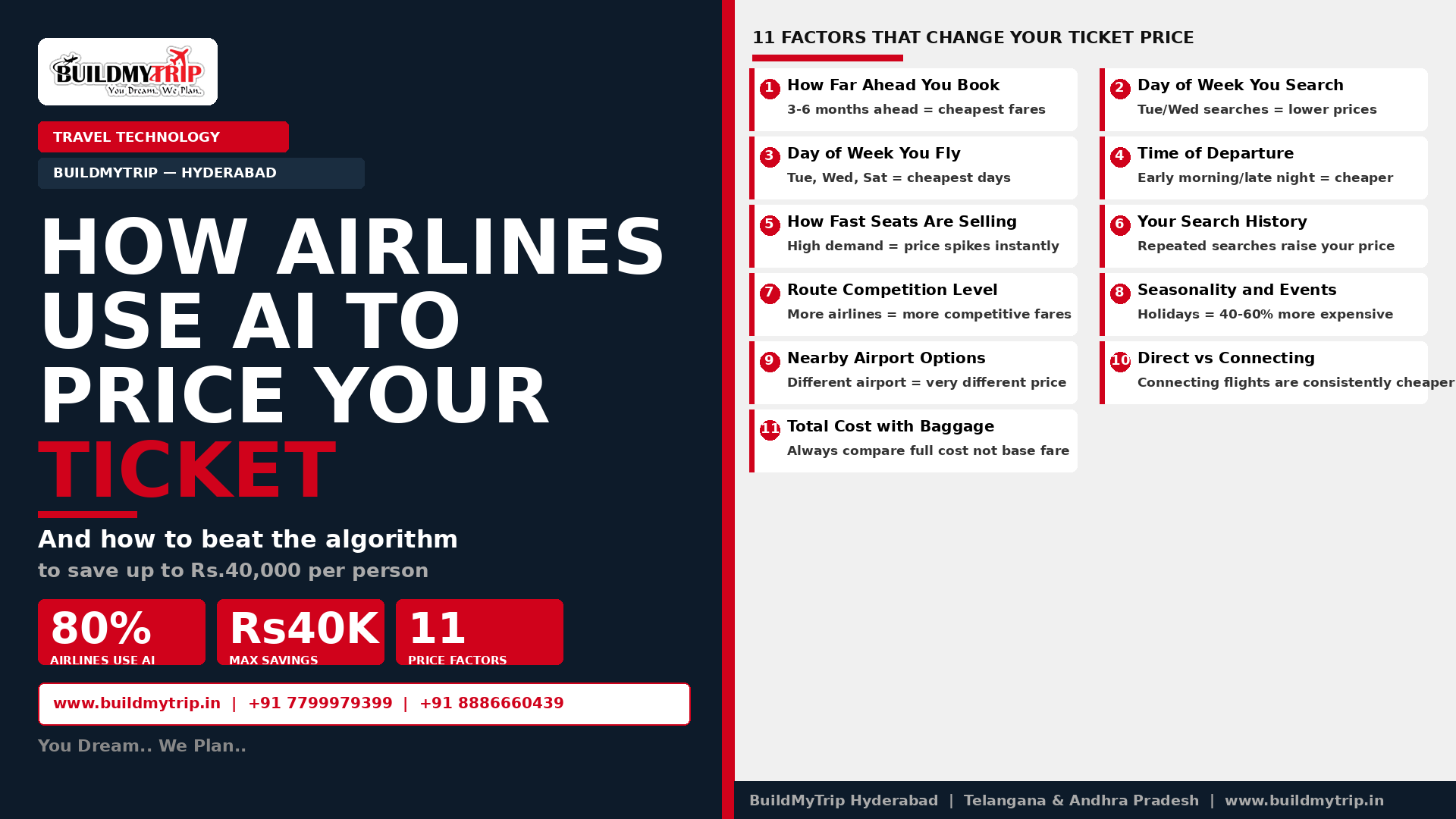
Around 80% of airlines worldwide now use some form of AI-driven dynamic pricing. The prices you see are not selected from a list. They are calculated fresh, in real time, every time someone searches for a flight.
The AI systems powering this — names like PROS, Sabre AirVision, Amadeus Altéa and the newer large market model systems — are processing millions of data points simultaneously. Every time you search for a flight, the algorithm is making a fresh calculation based on dozens of factors all at once.
What is the current demand for this route? How many seats are left? What are competitor airlines charging right now? What is the historical booking pattern for this route on this day of the week? What major events are happening at the destination? What is the fuel price today? How far in advance is this booking? What device is the customer using? What is the time of day?
All of these factors feed into a calculation that produces the price you see. And because thousands of people are searching simultaneously and the algorithm is updating constantly, the price literally changes multiple times per day. Sometimes multiple times per hour.
Airlines typically open bookings six to eleven months ahead. They start with a plan for how many seats should sell at different price points. The AI then adjusts constantly based on what is actually happening — if demand is higher than expected, prices go up. If seats are not selling, prices drop. If a competitor drops their price, the algorithm responds within minutes.
This is why the same flight on IndiGo or Air India can cost ₹8,000 one day and ₹22,000 five days later. The plane did not change. The route did not change. The algorithm responded to a surge in demand, a competitor pricing move, or a combination of factors that no human analyst could track manually.
The Surveillance Pricing Question — Are They Using Your Personal Data?
This is the question that has been making international news. Delta Airlines in the USA recently came under scrutiny after revealing it was testing AI-driven pricing that could theoretically charge two passengers different prices at the same moment.
The concern is what experts call surveillance pricing — using your personal data, your browsing history, your purchase history, your social media activity, to estimate how much you are willing to pay and charge you accordingly.
A pricing strategy expert at the University of Colorado explained it directly. On one side airlines are using AI to help human pricing analysts make faster and better decisions — that is reasonable and expected. On the other side there is the possibility of personalised pricing based on individual customer data — knowing you just bought a luxury item suggests you can pay more for a flight.
The truth about how far this has gone is not fully clear. Delta stated after public backlash that it does not use personal data to set individual prices. But the technology to do this exists, it is being tested, and regulatory bodies including the Federal Trade Commission in the USA are paying attention.
For Indian travellers, the practical implication is this — using incognito mode when searching for flights, clearing cookies, and searching on different devices or browsers can sometimes show you different prices. Whether this is because airlines are personalising prices or simply because the algorithm treats new sessions differently is debated — but the practice of searching incognito is widely recommended by frequent travellers.
The 11 Factors That Change Your Ticket Price
Now that you understand the system, let us get specific about exactly what makes your ticket price go up or down.
How far in advance you book is the biggest single factor. Airlines open bookings around 330 days before departure. The cheapest fares are typically available 3 to 6 months before a flight for international routes and 6 to 8 weeks before for domestic flights. Booking within 2 weeks of departure on a popular route is almost always significantly more expensive.
The day of the week you book matters. Tuesdays and Wednesdays historically show lower average fares because fewer people are searching and booking on these days. Weekends, when most people research and book trips, show higher average prices because demand is higher and algorithms respond accordingly.
The day of the week you fly matters separately. Flights departing on Tuesdays, Wednesdays and Saturdays are typically cheaper than Friday evening and Sunday flights which are peak departure times for both business and leisure travellers.
The time of day matters. Flights departing very early in the morning — before 6 AM — and very late at night are typically cheaper because fewer people want these departure times. Peak morning business hours and early evening are the most expensive flight times.
How quickly the seats are selling matters enormously. If a flight is filling up faster than the algorithm expected, prices will jump. If bookings are slow, prices drop to stimulate demand. This is why watching a flight price and waiting is a dangerous strategy — you can never know whether you are watching prices fall or about to see them spike.
Your search history and device can matter. As discussed — incognito browsing and clearing cookies is worth doing before booking.
The route's competition level matters. On routes where multiple airlines compete heavily — like Hyderabad to Dubai or Mumbai to Singapore — prices tend to be more competitive. On routes where one or two airlines dominate, you have less pricing protection.
Seasonality and events matter. School holidays in India, Diwali travel period, Christmas, summer, and major events at the destination all push prices significantly higher. Planning around these peak periods saves substantially.
Nearby airports matter. Sometimes flying from Hyderabad instead of Mumbai or vice versa, or flying to a nearby destination and taking a train, produces dramatically different prices. The algorithm prices routes individually.
Connection type matters. Direct flights always price higher than connecting flights. If you are price sensitive and time flexible, one-stop flights consistently offer better value.
Baggage and ancillaries matter increasingly. With budget airlines now operating on many routes, the base ticket price is just the beginning. Always compare total cost including baggage.
How to Actually Beat the Algorithm — Practical Steps
Now the part you actually came for. Here is what we tell every customer at BuildMyTrip who wants the best possible airfare.
Start your search early and track prices consistently. For Europe and long-haul international flights from Hyderabad, begin tracking 4 to 6 months before your travel date. Use Google Flights' price tracking feature — it notifies you when prices drop on your route. Set up alerts and check them regularly rather than doing one big search close to your travel date.
Use incognito mode for every flight search. Open a private browsing window in Chrome or use Firefox's private mode. This prevents your browser from carrying previous search history that might influence prices. Make it a habit.
Search on Tuesday and Wednesday. These are statistically the best days to find lower prices. Avoid searching on Friday evenings and weekends when demand and therefore prices peak.
Book on Tuesday or Wednesday. Not just searching — actually complete your purchase on a Tuesday or Wednesday. Many travel analysts have documented consistently lower transaction prices on these days.
Be flexible with your departure date by plus or minus three days. Google Flights has a calendar view that shows prices across a range of dates. Shifting your trip by two or three days can save ₹8,000 to ₹15,000 per person on international flights.
Fly on Tuesday, Wednesday or Saturday where possible. Avoid Friday evening and Sunday flights which are consistently the most expensive departure days.
Do not search repeatedly for the same flight on the same device without incognito. Repeated searches from the same browser can trigger higher pricing responses from some algorithms.
Compare direct and connecting options honestly. A one-stop flight through Dubai or Doha might add 3 to 4 hours to your journey but save ₹8,000 to ₹20,000 per person. Over a family of four that is a significant saving.
Use a flight comparison tool and then book directly. Google Flights and Kayak are excellent for comparison. But once you find your best price, booking directly on the airline's own website often gets you a slightly better deal than OTAs because airlines sometimes offer lower fares directly to avoid paying OTA commissions.
Watch out for the price drop after initial search. If you search for a flight, the price spikes, and you do not book — clear your cookies, wait 24 to 48 hours, and search again in incognito. Many people have found prices drop back after the algorithm no longer detects their interest.
The Best Windows to Book International Flights from Hyderabad
Based on what we see booking hundreds of international tickets every year from Hyderabad, here are the specific windows that consistently produce the best prices.
For Europe from Hyderabad — book 4 to 6 months in advance. The sweet spot for most European destinations is exactly 3 to 4 months before departure. Earlier than 6 months the prices are sometimes not at their lowest. Closer than 8 weeks they start climbing significantly for popular summer and shoulder season dates.
For Dubai from Hyderabad — book 6 to 8 weeks in advance for short trips. Dubai is a highly competitive route with many airlines so prices stay reasonable longer. However for peak periods like Diwali, Christmas or major Dubai events like Expo periods, book 3 to 4 months ahead.
For Southeast Asia — Thailand, Bali, Malaysia — book 2 to 4 months in advance. These routes are competitive from Hyderabad.
For domestic flights within India — book 6 to 8 weeks in advance for the best prices. Booking inside 2 weeks significantly increases costs on most routes.
For Kailash Mansarovar and other pilgrimage destinations — book as early as possible because availability is limited and prices respond sharply to demand.
What This Means When You Book Through BuildMyTrip
When you book your trip through us, we are actively using our knowledge of how airline pricing algorithms work to find you the best possible fares. We track price trends on your specific route, we know the booking windows that produce the best results, and we compare multiple airlines and routing options simultaneously.
We also understand that for most families in Hyderabad planning an international trip, the flight ticket is 30% to 40% of the total trip cost. Getting this right makes a real difference to your overall budget. A difference of ₹5,000 to ₹10,000 per ticket multiplied by a family of four is ₹20,000 to ₹40,000 — enough to upgrade your hotels or add another destination to your itinerary.
This is why we always recommend calling us before you book anything independently. Tell us your destination, your approximate travel dates, and your budget — and we will tell you when to book, which airline to use, and what the price is likely to do over the coming weeks.
That kind of advice does not cost you anything extra. It is just part of how we work.
Frequently Asked Questions
Does the airline algorithm actually track my searches and raise prices?
There is strong evidence that algorithms treat repeated searches from the same browser differently, which is why incognito mode is recommended. Whether this constitutes active personal tracking or is simply a result of cookie-based demand signals is debated. The safe practice is to always search in incognito and clear cookies before booking.
What is the single best thing I can do to get a lower flight price?
Book early and be flexible on dates. These two factors have more impact on your ticket price than anything else. Booking 3 to 6 months in advance for international flights from Hyderabad consistently produces significantly better prices than booking within 4 to 6 weeks.
Do flight prices actually drop closer to the departure date?
Sometimes yes — if a flight has many unsold seats very close to departure the airline may drop prices to fill them. But this is unpredictable and risky. On popular routes during peak periods prices almost always increase closer to departure. Waiting for a last-minute deal on flights is a high-risk strategy that most experienced travellers avoid.
Is Tuesday really the cheapest day to book flights?
Tuesday and Wednesday consistently show lower average fares across multiple studies. However this is an average — not a guarantee on every route and every day. It is one factor among many and worth using in combination with the other strategies above.
Does using a VPN help get cheaper flight prices?
Some travellers report seeing different prices when using a VPN to appear to be searching from a different country. This works on some routes and with some airlines because pricing can differ by market. It is a more advanced technique and results vary. The simpler steps — incognito, flexible dates, early booking — consistently produce better results.
Why do prices spike when I search the same flight multiple times?
The algorithm interprets repeated searches as high interest and rising demand for that seat. This can trigger a price increase to capture what the system predicts is a highly motivated buyer. Clearing cookies and using incognito prevents this.
Should I book flights on the airline website directly or through an OTA?
Both have advantages. OTAs like Google Flights are excellent for comparison across many airlines simultaneously. But airlines sometimes offer exclusive lower fares on their own websites to avoid paying OTA commission fees. After comparing on Google Flights, always check the direct airline website to see if a better direct price exists.
How much does AI pricing actually cost Indian travellers?
It is difficult to quantify precisely but the difference between booking at the optimal window versus booking last minute or at peak search times on a Hyderabad to Europe return flight can be ₹15,000 to ₹40,000 per person. Across a family of four that is ₹60,000 to ₹1,60,000 on flights alone — which is why understanding and working with the algorithm matters so much.
📞 +91 7799979399 📞 +91 8886660439 🌐 www.buildmytrip.in 📍 Hyderabad, Telangana
You Dream.. We Plan..
