
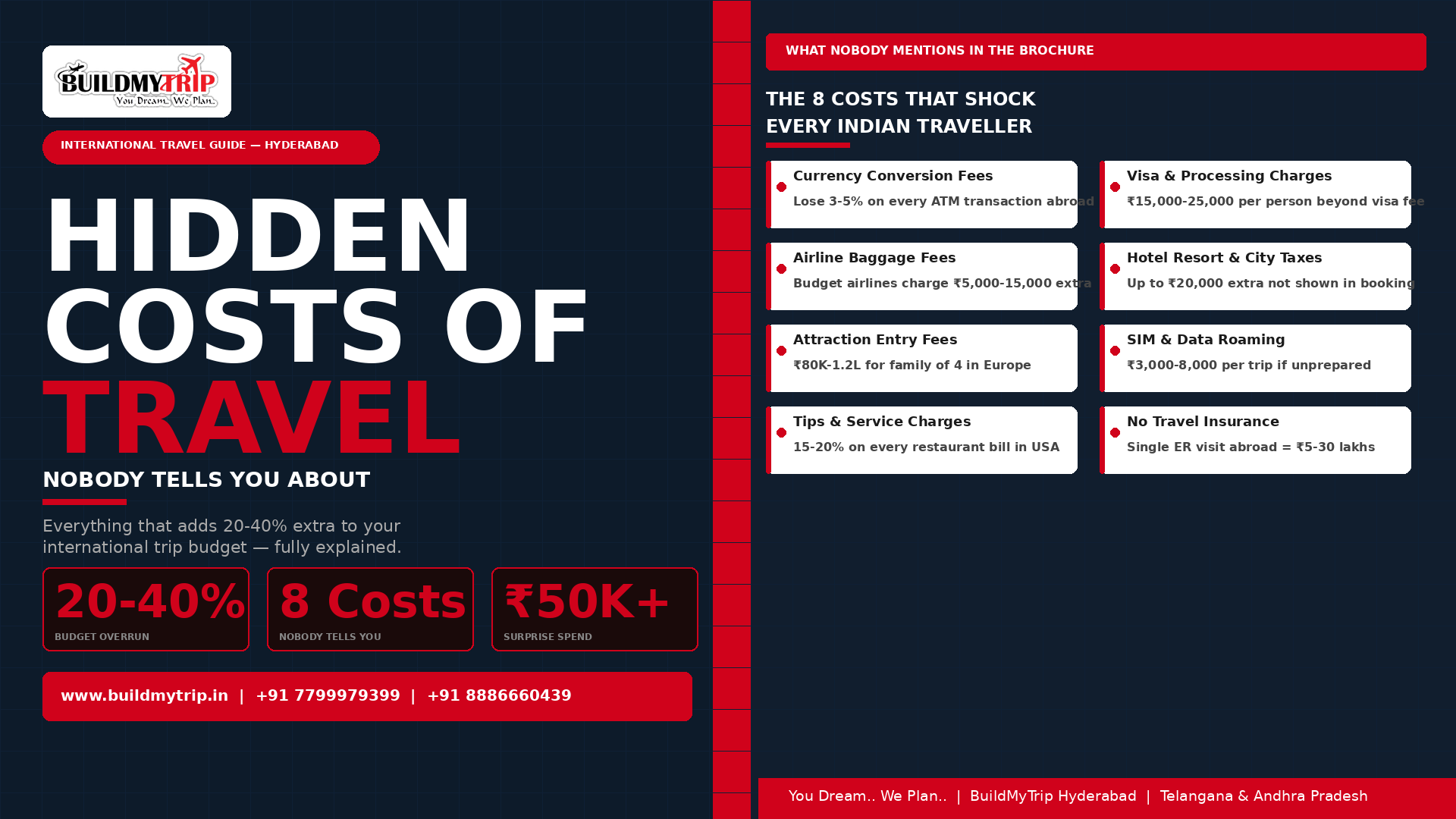
You saved for months. You got your passport. You booked the trip. You have a rough number in your head for what this holiday is going to cost.
And then you land abroad — and the real spending begins.
This is the conversation we have with almost every first-time international traveller who calls us at BuildMyTrip after coming back from their trip. "We thought we had budgeted properly. But we spent so much more than we planned." Almost every time, the reason is the same — nobody told them about the hidden costs.
This blog is our attempt to change that. We are going to tell you every single cost that travel brochures, OTAs and booking websites will never mention upfront — because they do not want you comparing the real total price before you book.
Read this before your next international trip. It will save you a significant amount of money and a lot of stress.
The Airport Costs Before You Even Board
Most people calculate their international trip budget starting with the flight ticket. But your spending starts much earlier — at the airport.
The first one is airport parking. If you drive to Rajiv Gandhi International Airport and park for a 10-day international trip, you are looking at parking charges that add up quickly. Many families from Hyderabad overlook this entirely because they assume a family member will drop them. When that does not happen, the bill comes as a surprise.
Then there is the porter, the trolley charge, the food you grab because you reach early and the restaurants at RGIA are not cheap. By the time you board your flight you may have already spent ₹2,000 to ₹4,000 that you never budgeted for.
At your transit airport — if you have a layover in Dubai, Doha or Abu Dhabi — the temptation to buy something or eat something is real. A simple meal for two at Dubai International Airport can cost ₹3,000 to ₹5,000 easily. Airport food anywhere in the world is significantly more expensive than outside. Budget for this or carry snacks from home.
Visa Fees — The Part Nobody Calculates Properly
You know you need a visa. You have probably budgeted for the visa fee. But most people forget that the visa fee is only one part of the visa cost.
For a Schengen visa from Hyderabad — which covers 27 European countries — the visa fee is €90 per person. But then there is the VFS Global service charge which adds approximately ₹2,500 per person. Then there is the travel insurance which is mandatory for Schengen applications and costs ₹2,000 to ₹5,000 depending on the coverage and duration. Then there is the cost of getting all your documents notarised, translated where required, and printed professionally.
By the time you have submitted your Schengen visa application for a family of four, you have spent ₹80,000 to ₹1,00,000 just on the visa process — before a single flight or hotel has been booked.
For Dubai, the visa is simpler and cheaper but still has processing fees. For USA and UK visas, the fees are significantly higher — ₹15,000 to ₹17,000 per person in visa fees alone, and these are non-refundable even if your visa is rejected.
The honest advice — always add at least ₹15,000 to ₹25,000 per person to your budget purely for visa-related expenses depending on your destination.
Currency Conversion — Where Lakhs Silently Disappear
This is the hidden cost that hurts Indian travellers the most and the one that is least understood.
When you land abroad and withdraw money from an ATM using your Indian debit card, three different charges hit you simultaneously. Your Indian bank charges a foreign transaction fee — typically 2% to 3.5% of the amount withdrawn. The ATM abroad charges its own withdrawal fee — often equivalent to ₹300 to ₹600 per transaction. And the exchange rate applied is usually not the actual interbank rate but a marked-up rate that gives the bank an additional 1% to 2%.
So on every ₹10,000 you withdraw abroad, you may be losing ₹600 to ₹800 in hidden charges. On a 12-day Europe trip where you withdraw money eight times — that is ₹5,000 to ₹6,000 lost purely on ATM fees.
Then there is dynamic currency conversion — a trap that catches almost every Indian traveller for the first time. When you pay by card abroad, the payment terminal sometimes asks "Would you like to pay in Indian Rupees?" This sounds convenient. Always say no. Always choose to pay in the local currency. When you choose rupees, the merchant applies their own terrible exchange rate and you lose 5% to 8% of the transaction value instantly.
The solution is straightforward. Get a forex card before you travel. Load it in the destination currency at your bank or at a forex dealer in Hyderabad. Carry enough cash for the first few days and use ATMs strategically — make fewer, larger withdrawals rather than many small ones.
Hotel Taxes and Resort Fees — The Check-In Surprise
This is a particularly common problem in the USA, Southeast Asia, and parts of Europe. You book a hotel online for what looks like a reasonable rate. You arrive at the hotel and at check-in they tell you there is a mandatory resort fee of $30 to $50 per night.
Resort fees are charged by hotels for amenities like the pool, WiFi, gym, parking, and other facilities — even if you never use any of them. In Las Vegas and Miami, resort fees of $40 to $60 per night are completely standard. On a 7-night stay that is $280 to $420 in extra charges that did not appear in the booking price.
European hotels add city taxes which vary by country and star rating. In Paris the city tax is €5 to €10 per room per night. In Barcelona it can be €4 to €5 per person per night. These are small amounts individually but over 10 nights for a family of four they add up to ₹15,000 to ₹20,000 that nobody planned for.
Always check the full cost breakdown on any hotel booking before confirming. Look specifically for "resort fee", "destination fee", "city tax" or "tourist tax" in the fine print.
Airline Baggage Fees — The Most Avoidable Hidden Cost
You booked a budget airline ticket because it looked cheap. Then you discovered that the ticket included zero checked baggage and your 23 kg suitcase costs more to check in than the original ticket price.
Budget airlines — including IndiGo, AirAsia, Scoot, Ryanair, EasyJet, and many others — operate on an unbundled pricing model. The base fare covers a seat and nothing else. Cabin baggage limits are strict — often 7 kg maximum. Checked baggage, meals, seat selection, priority boarding, and even printing your boarding pass at the airport are all charged separately.
A 23 kg checked bag on a budget European flight booked at the airport can cost €50 to €80 each way. For a family of four with four checked bags over a return journey, that is €400 to €640 in baggage fees alone — which can be more than the original flight tickets.
The fix is simple but requires planning. When you book your flight, always add your baggage allowance at the same time. Pre-booked baggage is always significantly cheaper than baggage added at the airport.
Also understand the difference between hand baggage and cabin baggage. Many Indian families pack heavy — sarees, gifts, extra shoes — and are shocked when their bag is weighed at the gate and they are charged excess fees on the spot.
SIM Cards and Data Roaming — The Silent Bill
Your Indian mobile plan does not work normally abroad. If you simply switch on your phone after landing and start using it — you are activating international roaming on your Indian number, which is charged at rates that will shock you when you see the bill.
Vodafone, Airtel and Jio all offer international roaming packs but they are expensive and often limited. For a 12-day Europe trip, an Airtel or Jio international pack costs ₹3,000 to ₹5,000 and gives you limited data — often 1 GB to 2 GB total for the whole trip. In a world where Google Maps, WhatsApp, and translation apps consume data constantly, this runs out quickly.
The smarter options are buying a local SIM at the destination airport — available in most European countries, Dubai and Southeast Asian destinations for ₹1,500 to ₹3,000 with generous data — or buying an eSIM online before departure which activates automatically when you land. Airalo and Holafly are popular eSIM services used by Indian travellers.
Alternatively, get a prepaid international SIM from Airtel or Jio stores in Hyderabad before departure — these are often better value than roaming packs.
Tips and Service Charges — The Unwritten Rules Abroad
In India tipping is appreciated but optional in most situations. Abroad — particularly in the USA, Canada, and parts of Europe — tipping is not optional. It is an expected part of the payment and in many countries it directly forms the income of service staff.
In America, tipping 18% to 20% on restaurant bills is standard. Not tipping is considered rude and will cause genuine discomfort. On a dinner for four at an American restaurant costing $80, you are expected to leave $15 to $16 as a tip. Across 10 to 12 days of eating out in America, tips alone can add $150 to $200 to your total spend.
In Europe, tipping norms vary by country but generally 10% is appreciated at restaurants. In the UK, 12.5% service charge is often added automatically to your bill — if you miss it and tip on top, you have tipped twice.
For tour guides, drivers, porters, and hotel housekeeping, tipping small amounts in local currency is customary across most international destinations. Budget ₹5,000 to ₹8,000 per person as a tipping fund for a 10-day trip.
Attraction Entry Fees — The One That Adds Up Fastest
Every travel brochure shows you photos of the Eiffel Tower, the Colosseum, the Vatican, the Louvre, Sagrada Familia, Neuschwanstein Castle and the Swiss mountain railways. What the brochures do not mention is that visiting all of these costs a significant amount of money.
The Eiffel Tower summit entry is €38.40 per person. The Louvre is €22 per person. The Vatican Museums including the Sistine Chapel is €20 per person. The Colosseum in Rome is €18 per person. The Sagrada Familia in Barcelona is €26 per person. The Jungfraujoch mountain in Switzerland — one of the most iconic views in Europe — costs approximately CHF 220 per person which is around ₹21,000 per person.
A family of four visiting these six attractions would spend approximately ₹1,20,000 to ₹1,40,000 purely on attraction entry fees. This is a number that almost no travel brochure ever shows you upfront.
Many attractions also require advance booking — especially in summer — and some charge a booking fee on top of the entry price. The Vatican, for example, is almost impossible to enter without pre-booking and last-minute online bookings carry a surcharge.
Travel Insurance — The Cost You Should Never Skip
Many Indian travellers skip travel insurance to save money. This is the single most dangerous financial decision you can make before an international trip.
A medical emergency abroad — even something as simple as food poisoning requiring a hospital visit in Europe or America — can cost ₹5 to ₹30 lakhs without insurance. A hospitalisation in the USA for even 48 hours can bankrupt a family without coverage.
Good travel insurance for a 12-day Europe trip costs ₹2,000 to ₹5,000 per person. For a family of four that is ₹8,000 to ₹20,000 — a tiny amount compared to what a single medical emergency would cost uninsured.
Travel insurance also covers trip cancellation, flight delays, lost baggage, missed connections, and emergency evacuation. It is Schengen visa mandatory anyway — so buy it, read it properly, and actually carry the documents with you.
The Little Things That Add Up to a Big Number
These are the expenses that individually seem small but collectively surprise every traveller.
Paying to use toilets is common across Europe — typically €0.50 to €1 per visit. Over 12 days for a family that adds up. Coin-operated luggage lockers at train stations and airports cost €3 to €8 per hour. Drinking water is not free at European restaurants — a bottle of still water typically costs €3 to €5. Guidebooks, maps, and printed tickets at tourist counters cost more than online versions. Souvenirs and gifts — the item that every Indian traveller spends far more on than planned.
Add all of these together across a 12-day trip for a family of four and you are looking at ₹30,000 to ₹50,000 in "miscellaneous" spending that was never in the budget.
The BuildMyTrip Approach — Total Cost Transparency
This is exactly why we tell every customer who calls us for a quote — give us 30 minutes and we will build you a real total cost, not a marketing number.
At BuildMyTrip, our quotes include flights, hotels, visa guidance, travel insurance, airport transfers, local transport between cities, and a realistic daily budget estimate covering food, entry fees, and local expenses. We also tell you specifically what to expect in tipping costs, SIM card expenses, and currency conversion savings.
When you book with us, you know the real number before you spend a single rupee. That is the only way we know how to do business.
Call us today and let us build your complete Europe or international trip budget — no surprises, no hidden costs, just honest numbers.
📞 +91 7799979399 📞 +91 8886660439 🌐 www.buildmytrip.in 📍 Hyderabad, Telangana
You Dream.. We Plan..
Frequently Asked Questions
How much extra should I budget beyond my main package cost for an international trip?
A realistic buffer for hidden and miscellaneous costs is 20% to 30% of your main package cost. So if your flights and hotels cost ₹2 lakhs per person, budget an additional ₹40,000 to ₹60,000 per person for visa, insurance, tips, entry fees, food outside included meals, currency conversion and local transport.
Is a forex card better than using my Indian debit card abroad?
Yes, significantly. A forex card loaded in the destination currency saves you the foreign transaction fee (2% to 3.5%), gives you a better exchange rate than ATM withdrawals, and protects you from dynamic currency conversion. Get one from your bank or a forex dealer in Hyderabad before you travel.
Do European hotels charge extra beyond the booking price?
Yes. European countries charge a city tourist tax that is collected separately at check-in. This is typically €2 to €10 per person per night depending on the country and hotel rating. Always ask about this when comparing hotel prices.
How much should I budget for food on an international trip?
This varies significantly by destination. In Southeast Asia — Thailand, Bali, Malaysia — you can eat well for ₹1,500 to ₹3,000 per person per day. In Europe, budget ₹4,000 to ₹7,000 per person per day for three meals including one proper restaurant dinner. In the USA, budget ₹6,000 to ₹10,000 per person per day including tips.
Is travel insurance really necessary for a short international trip?
Absolutely yes — especially for Europe which requires it for a Schengen visa, and for any destination where medical costs are high. The USA, UK, Canada, Australia and most of Europe have extremely high healthcare costs for uninsured visitors. Travel insurance costing ₹2,000 to ₹5,000 protects you against costs that could reach lakhs.
Why do budget airline tickets end up costing more than full-service airlines?
Budget airlines charge separately for everything beyond the basic seat — checked baggage, meals, seat selection, and even boarding pass printing. When you add all these costs, the final price often equals or exceeds a full-service airline ticket that includes all of these. Always compare total costs including baggage when choosing between airlines.
What is dynamic currency conversion and how do I avoid it?
Dynamic currency conversion is when a foreign merchant offers to charge your card in Indian Rupees instead of the local currency. This sounds convenient but the exchange rate applied is typically 5% to 8% worse than your card's standard rate. Always choose to pay in the local currency when using your card abroad.
How much do attraction entry fees typically cost in Europe per person?
Major European attractions cost between €15 and €40 per person for entry. Iconic experiences like the Jungfraujoch in Switzerland or a gondola ride in Venice cost significantly more. For a family of four doing a 12-day Europe trip visiting 8 to 10 major attractions, budget ₹80,000 to ₹1,20,000 purely for entry fees across the family.
